
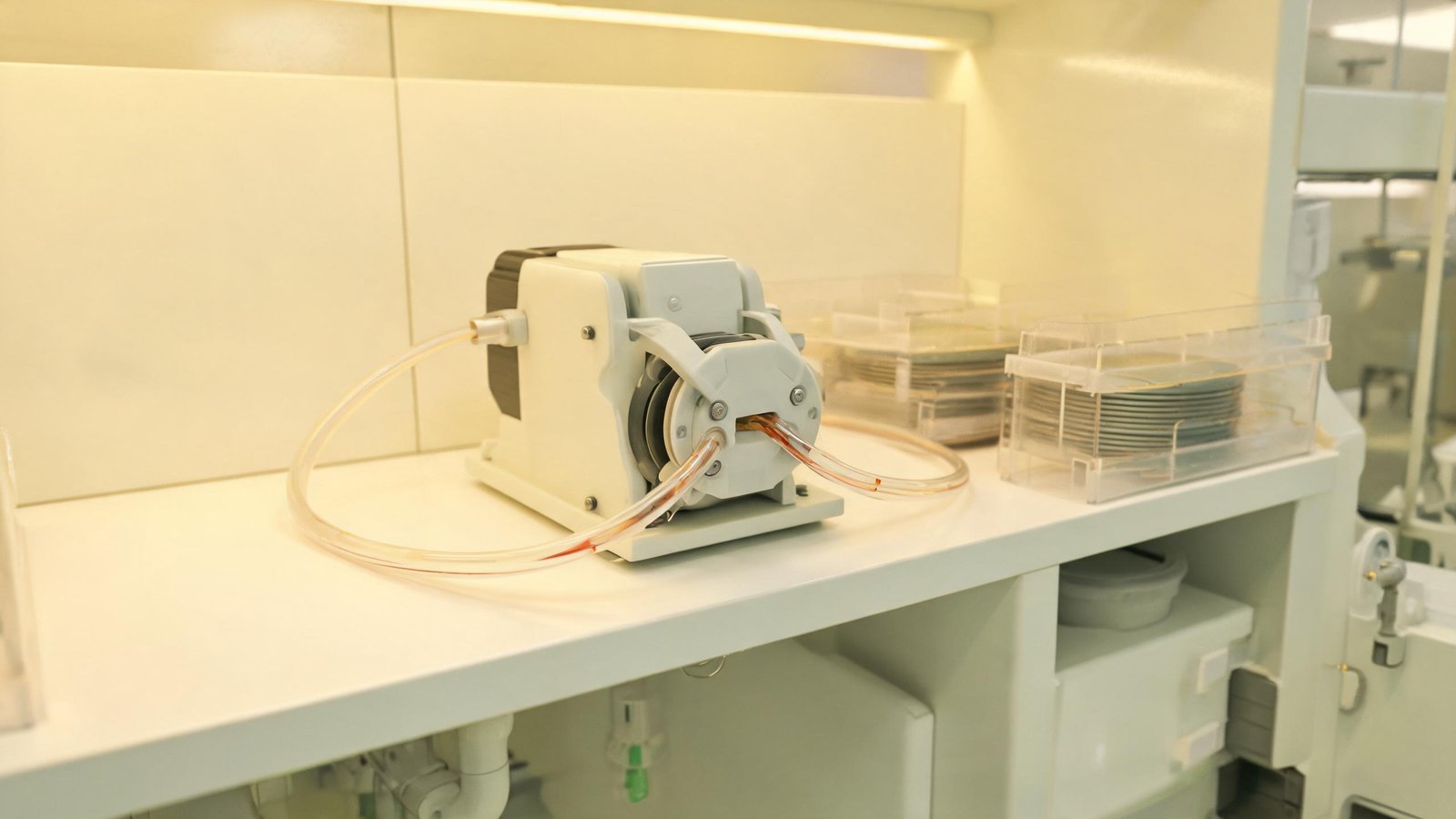
Chemical fluid handling in semiconductor fabs demands a level of contamination control that few other industries require. Process chemicals — from ultrapure water to buffered oxide etch, hydrogen peroxide, and CMP slurries — must be delivered to process tools without introducing particles, metal ions, or organic contaminants. Peristaltic pumps address this requirement by confining the fluid entirely within tubing, isolating it from pump internals that could shed particles or leach metals.
This article compares peristaltic pump-based fluid delivery with alternative pump technologies used in semiconductor manufacturing, evaluating where each approach fits and what engineering tradeoffs apply when selecting a pump for wafer processing applications.
What Makes the Options Different
Three pump technologies commonly appear in semiconductor fluid delivery: peristaltic (tubing), bellows, and diaphragm. Each isolates the process fluid from the motor and drive mechanism, but they differ in how that isolation is achieved.
| Feature | Peristaltic Pump | Bellows Pump | Diaphragm Pump |
|---|---|---|---|
| Fluid isolation | Tubing only — no valves or seals | Bellows chamber with check valves | Diaphragm with check valves |
| Wetted materials | Tubing material (PTFE, silicone, PharMed) | PTFE/PFA bellows and valves | PTFE diaphragm, valve seats |
| Particle contribution | Low — no internal sliding parts in fluid path | Low — non-metallic bellows flex | Moderate — valve seating wear |
| Maintenance | Tubing replacement only | Bellows and valve replacement | Diaphragm and valve replacement |
| Flow stability | Pulsatile — depends on roller design | Lower pulsation at high speed | Moderate pulsation |
For semiconductor fabs operating under SEMI Standards for ultrapure water and chemical distribution, the key differentiator is particle contribution. Peristaltic pumps have no valves, no sliding seals, and no internal cavities where process chemicals can stagnate or crystallize. This makes them particularly suitable for point-of-use chemical delivery and CMP slurry dispensing.
Bellows pumps use a flexible PTFE or PFA bellows that expands and contracts to move fluid through check valves. While the wetted materials are high-purity fluoropolymers, the check valves open and close on every stroke — creating sliding contact surfaces that can generate microscopic particles over thousands of operating hours. Diaphragm pumps share this limitation: the check valves required for one-way flow are inherent wear points.
For semiconductor process engineers, the question is not simply whether a pump can move the chemical, but whether it can do so without adding particles or extractable ions to the process stream. A pump that introduces even trace metallic contamination from valve springs or seat materials can compromise wafer yields — particularly at advanced technology nodes where feature sizes are measured in single-digit nanometers.
Flow Control
CMP slurry delivery requires consistent flow to maintain uniform polishing rates across the wafer. Peristaltic pumps with stepper-motor drives can achieve flow accuracy in the range of ±0.5% when properly calibrated. However, the pulsatile nature of peristaltic flow — caused by the cyclic compression and release of tubing — can affect downstream pressure stability.
In applications where pulse-free flow is critical, a cased peristaltic pump paired with a pulse dampener or accumulator can reduce pressure variation. The alternative — a bellows pump — produces lower pulsation at high speeds but introduces check valves that can wear and generate particles over time.
For smaller flow rates typical of laboratory-scale wafer processing or development tools, a K15 micro peristaltic pump provides sufficient resolution for precise dosing of etching chemicals. At higher throughput, a K45 large flow pump can handle the volume demands of production-scale CMP slurry delivery.
CMP slurry presents an additional challenge: the abrasive particles (silica, alumina, or ceria) suspended in the carrier fluid can settle if flow velocity drops. Peristaltic pumps help maintain suspension because the tubing flexes continuously, keeping the slurry agitated. In contrast, bellows and diaphragm pumps have internal cavities where slurry can stagnate, settle, and harden — requiring flush cycles that add complexity to the tool design.
Etching chemical delivery also benefits from peristaltic pump characteristics. Wet etching processes use hydrofluoric acid (HF), buffered oxide etch (BOE), phosphoric acid, and ammonium fluoride solutions at specific concentrations. These chemicals are hazardous and must be contained. The tubing-only fluid path of a peristaltic pump means that a leak results in tubing replacement — not a seal failure that could spray chemical into the fab environment.
Pressure Requirements
Semiconductor chemical delivery systems operate at relatively low pressures — typically 15–50 psi for point-of-use dispense. Peristaltic pumps are well-suited for this range. Their pressure limitation (determined by tubing burst strength and occlusion force) is generally below 30 psi for standard tubing, which is adequate for most fab chemical delivery loops.
Centralized chemical delivery systems that pressurize bulk chemical containers may require higher pressures, where bellows or diaphragm pumps are more appropriate. The distinction matters: peristaltic pumps excel at point-of-use dispensing where precision and contamination control outweigh raw pressure capability.
Tubing and Fluid Compatibility
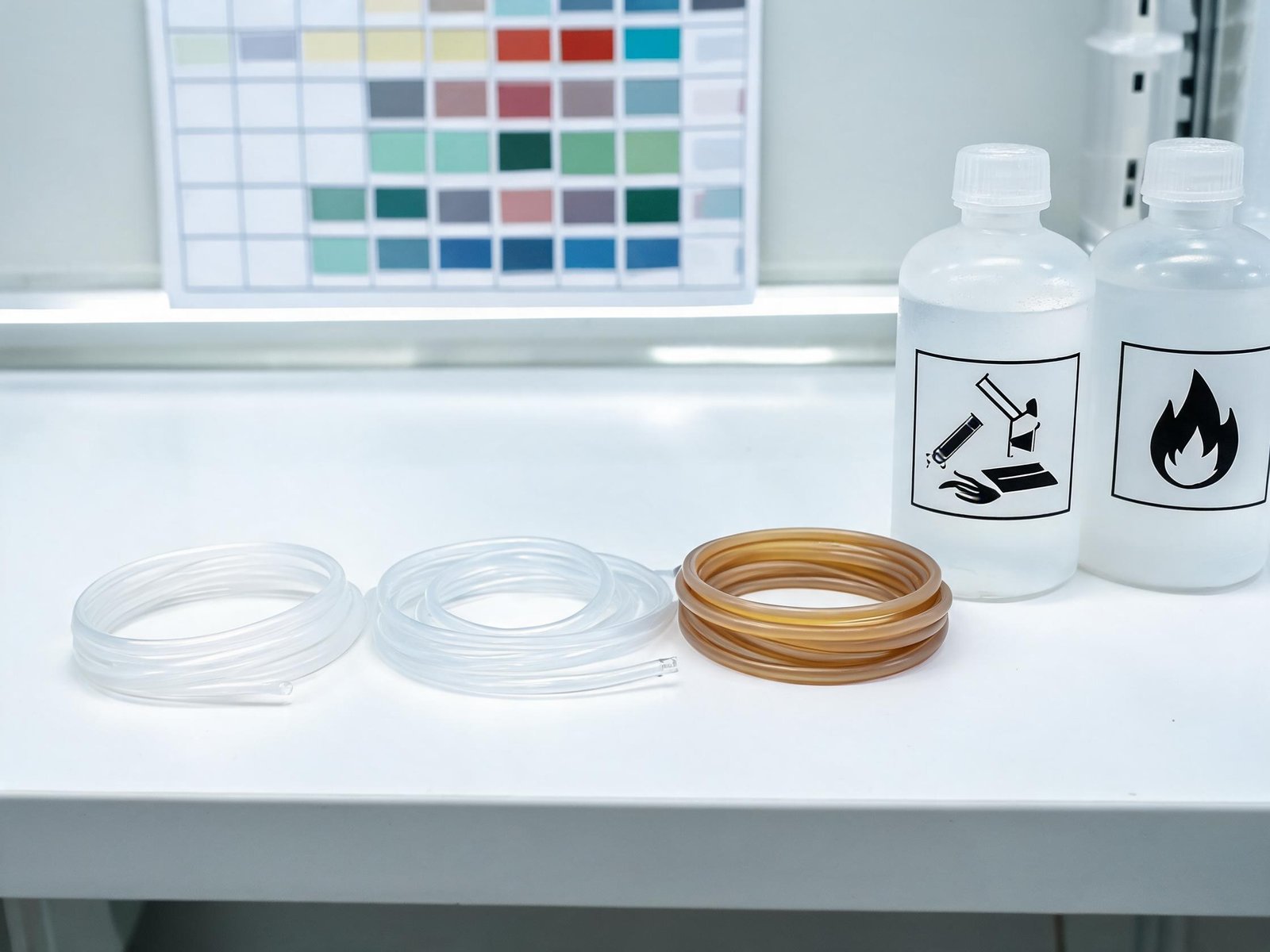
Tubing material selection is the primary engineering decision for semiconductor peristaltic pump applications. The tubing must simultaneously resist chemical attack, minimize particle shedding, and maintain mechanical integrity over its service life.
| Tubing Material | Suitable Chemicals | Limitations |
|---|---|---|
| PTFE | HF, H2SO4, H2O2, HNO3, TMAH | Stiff — requires compatible pump head |
| Silicone | UPW, mild aqueous solutions | Not suitable for strong solvents or acids |
| PharMed BPT | Broad chemical resistance | Higher cost — verify per specific chemical |
| Viton (FKM) | Hydrocarbons, mild acids | Not compatible with ketones, amines |
For semiconductor applications, tubing selection should be validated against the specific process chemical list, including concentration, temperature, and exposure duration. SEMI F57 defines limits for leachable ions and metals in polymer components used in ultrapure water and liquid chemical distribution systems — tubing suppliers should be able to provide compliance data when requested.
Maintenance
Peristaltic pump maintenance in semiconductor environments is straightforward: replace the tubing. No disassembly of valves, bellows, or diaphragms is needed. Tubing replacement intervals depend on duty cycle, chemical exposure, and tubing material — typically 500–2,000 hours of continuous operation. For PTFE tubing in aggressive etchant service, the interval may be shorter due to material stiffening and fatigue at the roller contact points.
In contrast, bellows and diaphragm pumps require periodic replacement of check valves, seals, and the bellows or diaphragm itself. These procedures are more complex and carry a higher risk of introducing contamination during maintenance, particularly in ISO Class 1–3 cleanrooms as defined by ISO 14644 cleanroom standards. Valve replacement in these pumps requires opening the fluid path, which means the pump must be flushed, drained, and requalified before return to service — a process that can take several hours and requires cleanroom protocol compliance.
Tubing replacement on a peristaltic pump, by comparison, takes minutes. The old tube is removed, a new section is loaded into the pump head, and the pump is ready for operation. This difference in maintenance complexity has direct implications for tool uptime in production fabs where chemical delivery pumps run continuously.
The U.S. government has invested heavily in expanding domestic semiconductor manufacturing capacity through the CHIPS Act, with NIST’s CHIPS Program Office overseeing manufacturing incentives. As new fabs come online, process engineers specifying fluid handling equipment should weigh the contamination control advantages of peristaltic pumps against the flow and pressure capabilities of alternative technologies.
Which Option Fits the Application?
The selection between peristaltic, bellows, and diaphragm pumps depends on the specific semiconductor process step:
- CMP slurry dispense — Peristaltic preferred for low particle contribution and easy tubing replacement
- Etching chemical delivery — Peristaltic with PTFE tubing for HF, HNO3, and buffered oxide etch
- Bulk chemical transfer — Bellows or diaphragm for higher pressure and central supply
- Laboratory/development tools — Peristaltic for flexibility and low cost of ownership
- UPW polishing loop — Bellows for continuous high-purity circulation
For OEMs developing wet processing tools, specifying the process chemical list, required flow range, and target particle specification to the pump supplier early in the design cycle helps ensure the right pump technology and tubing material are selected from the start. YOORAIN can provide guidance on peristaltic pump configurations for semiconductor-grade chemical delivery applications.